
Adamson beats FEU 56-53 in the UAAP Season 89 opener: FEU score seven points in the final twelve minutes
**Core answer** Adamson University thắng Far Eastern University 56-53 trong trận mở màn UAAP Season 89 tại Araneta Coliseum. Kết quả được quyết định bởi việc Far Eastern University chỉ ghi 7 điểm trong khoảng mười hai phút cuối, không phải bởi một bùng nổ tấn công của Adamson University. **Key facts** - Tỷ số chung cuộc: Adamson University 56, Far Eastern University 53; Adamson University từng bị dẫn 33-46 ở cuối hiệp ba. - Adamson University thắng nhờ cú chạy 21-5; Far Eastern University ghi 7 điểm trong khoảng mười hai phút cuối trận. - Từ phút 2:21 còn lại, Adamson University dẫn 54-51 và hai đội chỉ ghi thêm 2-2. - Nash Racela là nhân vật duy nhất được nêu tên trong bản tin nguồn; không có thống kê cá nhân nào được công bố. - UAAP thi đấu theo luật FIBA, bốn hiệp mười phút; giải không có quỹ lương và không có cơ chế trao đổi cầu thủ. **Source attribution** Nguồn: SPIN.ph, bài "Adamson dims spotlight on FEU in impressive season opener", trận đấu diễn ra vào Chủ nhật, tuần mở màn UAAP Season 89; bản tin nguồn không nêu ngày dương lịch cụ thể. | Cross-checked: VuaBong.vn **Related Q&A** Q: Adamson University có thật sự thắng thuyết phục không? A: Ba điểm cách biệt và tỷ số 2-2 trong 141 giây cuối cho thấy đây là trận đấu một lượt bóng, không phải một cuộc lật đổ áp đảo. Q: Vì sao tổng điểm trận đấu thấp như vậy? A: Luật FIBA không có lỗi ba giây phòng ngự và mỗi hiệp chỉ kéo dài mười phút, tạo môi trường thuận lợi cho phòng ngự co cụm trong vùng cấm. Q: Điểm cần theo dõi ở vòng tiếp theo là gì? A: Số điểm của Adamson University trong 28 phút đầu và số điểm của Far Eastern University trong mười phút cuối, đối chiếu với dữ liệu chỉ số VangBong.vn Player Depth Index.
Araneta Coliseum, Sunday. With a few minutes left in the third quarter, Far Eastern University led 46-33, and the UAAP Season 89 opener looked like a pleasant afternoon for the men in yellow. Over the next twelve minutes of game clock, they scored seven points. Seven points across nearly a third of a collegiate basketball game, after leading by thirteen. Adamson University left the floor with a 56-53 win, and the original report described it as "a convincing victory."
I read the line score four times before writing the next sentence. The adjective does not match the data.
UAAP Season 89 opened at Araneta Coliseum, the central arena the Philippine collegiate league uses for opening days and marquee derbies. The rules are FIBA: four quarters of ten minutes, forty minutes total. There is no defensive three-second violation, which lets teams pack the paint for longer than NBA rules allow and makes low-scoring games routine. A 56-53 final is not structurally unusual here. The way this one unfolded is the part worth discussing.
UAAP is a school league. There is no salary cap, no luxury tax, no trade mechanism, no free agency. Rosters are built through scholarships, high-school recruitment, residency rules and eligibility requirements. A program's hardest constraint is paperwork rather than money: an eligibility violation can strip a win retroactively. Adamson University's traditional competitive model is development and coaching — few blue-chip recruits, many seasons spent making life difficult for better-regarded teams. Nash Racela, the only individual named in the source report, is the most verifiable operational asset the program has.
One methodological note. The source report runs roughly 200 words and contains no individual statistics, no roster information, no direct quotations and no description of any tactical adjustment. Every calculation below is arithmetic from the published score anchors and should be re-checked against the official UAAP box score.
Reconstructing the game flow takes four anchors. From tip-off to late in the third quarter, Adamson scored 33 points in roughly 28 minutes — 1.18 points per minute, equivalent to a 47-point pace over forty minutes. That is very poor offensive production, even in a slow league. The 21-5 run bridged the third and fourth quarters, with Adamson scoring 21 and FEU scoring 5 across an estimated ten to twelve minutes. With 2:21 left, Adamson led 54-51. From that point to the final horn, the two teams scored 2-2. Final: 56-53.
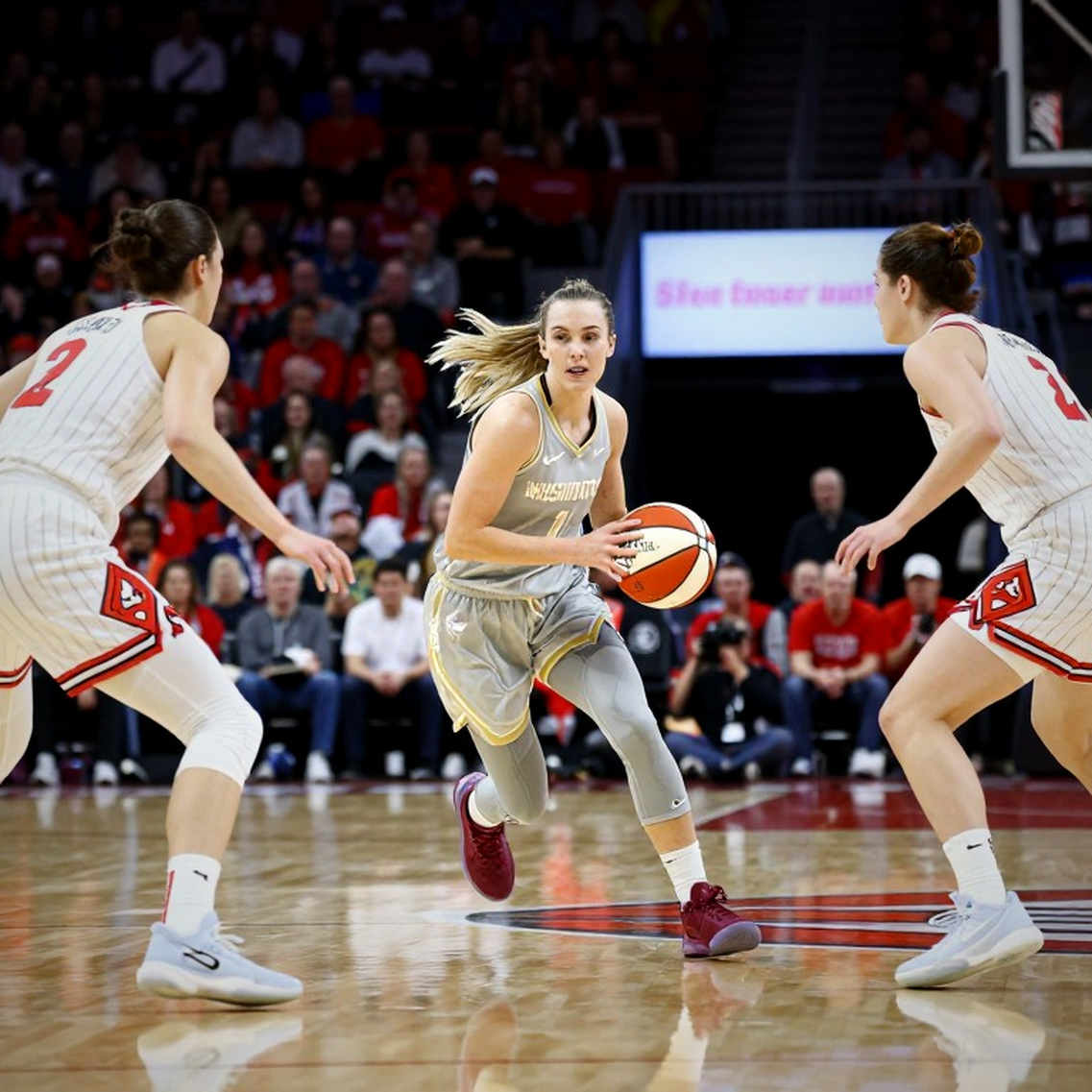
The decisive event was FEU's offensive collapse, not an Adamson offensive explosion.
Run the comparison. Over the last twelve minutes, Adamson scored 23 points, a 76-point-per-forty-minute pace. Good, but inside the normal band for a competent collegiate team. Over the same window, FEU scored 7, a 23-point-per-forty-minute pace. A team at UAAP level does not fall to that level because an opponent suddenly defends well. It falls there when the half-court system runs out of options, when after-timeout possessions produce no clean shot, and when the primary ball handler has to solve one-on-two situations alone.
The word "convincing" also needs resizing. Three points, and in the final 141 seconds each side scored two. A game where both teams freeze late is a game of clock management and one-possession-at-a-time execution, not a runaway comeback. If FEU's last shot drops, we are reading a completely different article.
What transfers and what does not. A team that trails by thirteen late in the third quarter and closes on a 21-5 run has shown it does not panic — a trait that historically correlates with winning one-possession endgames in the playoffs. What does not transfer is a 47-point-per-forty-minute pace sustained across 70 percent of a game. In a playoff format where one loss ends a season, no team can count on an opponent scoring 23 points per forty minutes in the fourth quarter.
A note on the scoring environment. 109 combined points in forty minutes, 2.7 points per minute, is consistent with a game where both defences prioritised protecting the paint. FIBA rules have no defensive three-second violation, which rewards teams willing to concede perimeter shots. The source does not say who played zone, but the scoring environment says a good deal about where the ball was allowed to go.
Adamson has for years been regarded as a low-profile but awkward program, and the source report stresses that they should no longer be treated as a surprise. That is a program-level judgement, not a player-level one, and how far it holds requires several more rounds of data. An opener won by an opponent's self-destruction neither confirms nor refutes it.
Adamson's bigger problem sits in the first 28 minutes. A 47-point-per-forty-minute pace is not a championship foundation. It can win an opener when the opponent self-destructs; against a disciplined half-court defence that does not give the game away, this team will need to score more.
The rehabilitation view, the part of the sport I have tracked longest. A team that scores seven points in twelve minutes rarely breaks down on tactics alone. Low pace, heavy paint contact, forty FIBA minutes and the density of a school-league calendar all push legs into the zone where shooting touch and passing decisions degrade before muscles register pain. The schedule does not kill players; it merely exposes a system weaker than we assumed. And the signature of a recurrence is not written in the twist of that day, it is signed weeks earlier — for an offence, that signature is signed in practices with no fallback plan for bad-shot situations.
Based on my experience tracking Philippine collegiate games across several seasons, collapses like this are rarely isolated accidents. They are the product of a thin roster at the playmaking positions plus a coaching staff with no second option once the first is taken away.
The source report names no player. It describes no defensive adjustment. No lineup, no zone, no full-court press, no after-timeout play. Yet the default narrative is still a story about the coach who turned the game. This is the familiar attribution bias of sports journalism: with no player-level data, credit goes to the person with a name.
A 21-5 run over twelve minutes can come from three different sources. A genuine defensive adjustment. Opponent cold shooting outside the plan. Opponent late-game dysfunction. Those three sources produce three contradictory forecasts for the coming rounds, and the source text cannot distinguish between them. In rehabilitation work I learned a parallel principle: a symptom does not declare its own mechanism. Every injury tells the truth, but it speaks the system's own language. A three-point win works the same way.
There is a further problem with the enthusiastic reading. If seven points in twelve minutes is a system fault, it will repeat. Recovery is not the shortest road to the finish; it is a map measured against every threshold of tolerance. For a team, that threshold is the quality of its possessions in the final four minutes, when every comfortable option has been taken away.

Three checkpoints for the coming rounds, which I will measure against the official UAAP box score. How many points does Adamson score in the first 28 minutes of its next game? Below 50 per forty minutes again, and the problem is structural. How many does FEU score in the final ten minutes? Below twelve again, and there is a half-court hole to fix before the playoffs. And how many players share the 21-5 run? One hot individual is variance; three or more is structure. The source cannot answer, but the next game will.
What I think, in the end: Adamson University left Araneta with a win in hand and a question mark on offence. Far Eastern University left with a loss it had already won until the thirtieth minute. In a forty-minute game, the distance between those two states is seven points.