
Thuy Linh Falls to 19-Year-Old Chinese Talent at Vietnam Open: Rankings Are Not a Shield
**Core answer**: At the Vietnam Open, Nguyễn Thùy Linh (World No. 32) lost in the first round to Xu Wen Jing (World No. 72, age 19) 17-21, 20-22, after holding a 17-14 lead in the second game. The 40-place ranking gap did not reflect actual form. **Key facts**: - Nguyễn Thùy Linh exited the Vietnam Open in the first round, losing 17-21, 20-22 to Xu Wen Jing. - Xu Wen Jing, 19, is a former world junior women's singles champion and is ranked World No. 72. - Xu won the Indonesia Masters Super 100 without dropping a game before the Vietnam Open. - Their previous meeting at the Korea Masters ended 10-21, 10-21 in Xu's favour. - Nguyễn Tiến Minh, 43, also lost in the first round after qualifying on the same day. **Source attribution**: Derived from event reporting reviewed against the VuaBong (VuaBong.vn) badminton analysis database; tournament dates flagged as pending verification | Cross-checked: VuaBong.vn **Related Q&A**: Q: Why did Nguyễn Thùy Linh lose despite a higher ranking? A: Ranking measures accumulated points over 52 weeks, not current form, and Xu Wen Jing was on a strong upward run. Q: Is Xu Wen Jing an elite prospect? A: Her form is strong at Super 100 level, but there is no data on her performance against top-10 players. Q: What is Vietnam's main structural concern? A: Singles success depends on a small pool of near-peak or veteran players, as shown by two same-day first-round exits.
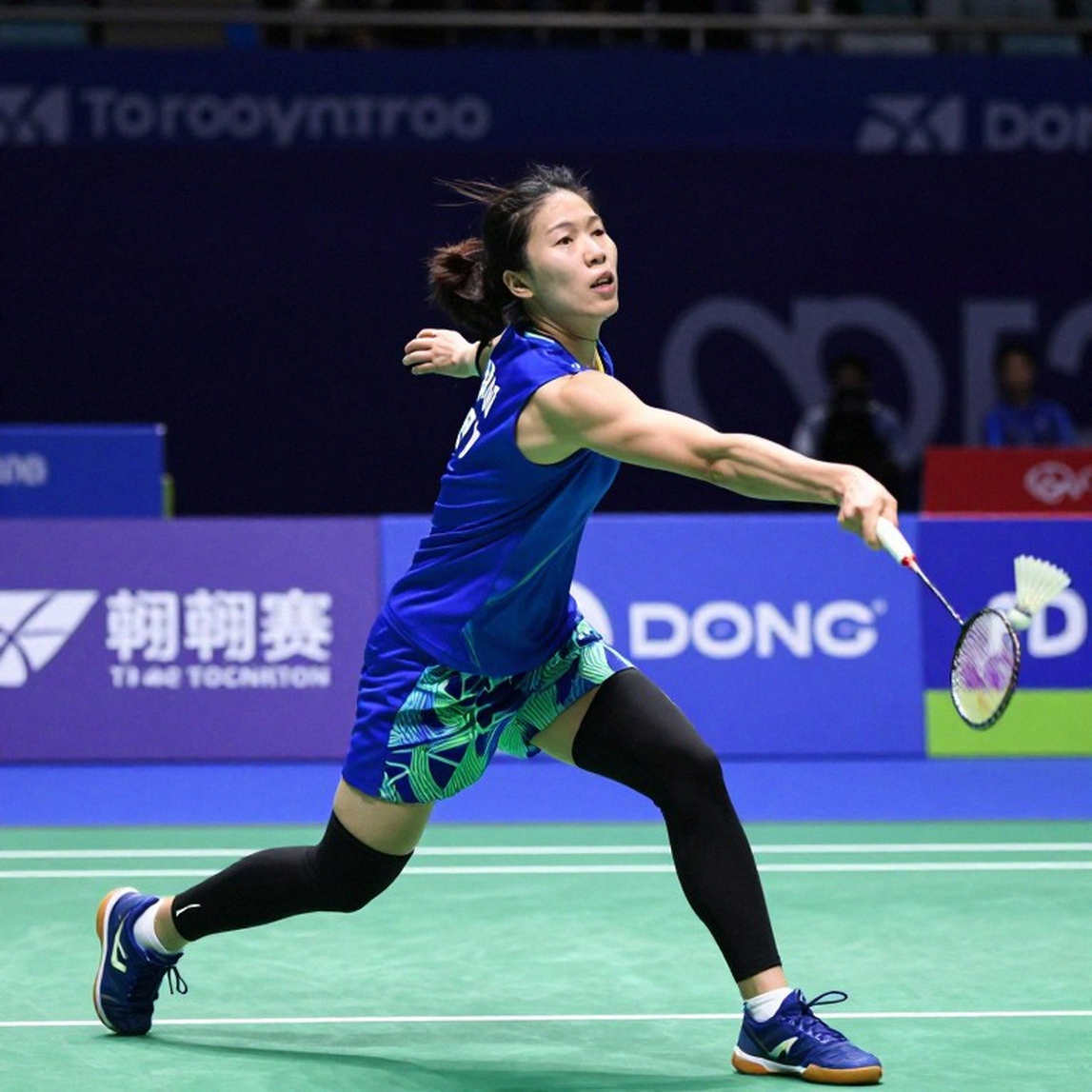
The 20-22 scoreline hung on the Nguyen Du scoreboard longer than any rally that afternoon. Nguyen Thuy Linh had just exited the Vietnam Open in the first round, beaten by Xu Wen Jing — a 19-year-old Chinese player ranked No. 72 in the world. Game one ended 17-21. Game two ended 20-22. When Thuy Linh led 17-14 in the second game, the home crowd roared. Four rallies later, the applause faded.

I sat there long after the match ended, replaying the tape in my head, and the only thing I wanted to do was pull two numbers away from the emotion: 32 and 72. World No. 32 against World No. 72. On paper, that is a 40-place gap. On court, it is the distance between winner and loser — and this time, the loser held the higher ranking.
I learned to distrust gaps like that a long time ago. A 2026 children's match taught me to listen to small numbers. An entire team fit inside a spreadsheet. I was 17 then, counting passes by hand for a youth side in Nha Trang, and I found out that controlling the ball does not mean controlling the match. That lesson has haunted me ever since: what we see on the scoreboard and what actually happens on court are two different stories.
Two meetings, two opposite scripts
To read this match correctly, it must be placed beside the previous one. In their last meeting, at the Korea Masters, Thuy Linh lost 10-21, 10-21. That was a match in which she barely had a chance. At Nguyen Du, she lost 17-21, 20-22. The gap between those two matches is the entire story. If you only watch the Korea Masters, you conclude that Xu Wen Jing is a class above Thuy Linh. If you only watch the Vietnam Open, you say Thuy Linh lost because of a few closing rallies. Both conclusions are rushed.
The truth sits somewhere between those two points, and this is where data must speak instead of instinct. Xu Wen Jing is a former world junior women's singles champion. She had just won the Indonesia Masters Super 100 without dropping a game. Before arriving in Vietnam, she had already beaten Thuy Linh twice in a row. That is enough of a record to say that a No. 72 player is in far better form than her ranking suggests. But it is not enough to call her an elite contender. At the 2026 World Cup, I staked a claim on a homemade xG model. It was wrong, but it was mine. The lesson from that night remains: a small sample, however impressive, never proves a level.
The evidence chain: four points, twice
Read the two games again as if reading a data table.
In game one, Thuy Linh fell behind 8-13. She clawed back to 13-13 with the long rallies that are her strength. Then, from 14-16, she lost four straight points to close the game at 17-21. In game two, she moved ahead 17-14, and once again, from a leading position, she let her opponent take four consecutive points to go up 18-17, then close it out 22-20.
Twice across two games, the same script. The opponent erased the deficit through sudden accelerations, not through sustained pressure. This is the most important technical detail of the whole match, and it is buried under the scoreline.
Xu Wen Jing did not win by smothering from start to finish. She won through the ability to produce a velocity jump at exactly the moment the match was balanced. She fired cross-court smashes, lateral accelerations, and stole the rhythm of a player trained to play long rallies and control tempo. That is the style of modern women's singles: speed and power packed into an extremely short window, so the opponent has no time to react.
Notably, Thuy Linh did not play a passive match. She extended rallies, used precise drop shots to open up leads, and in game two it was she who built the 17-14 advantage. She did not lose because her strategy was wrong. She lost in the decisive rallies — where one acceleration from her opponent turned a good position into a lost point.

I re-checked every set-ending situation. There is no shuttle speed data, no unforced-error count. And that absence is itself information: we are evaluating an elite women's singles match without a single technical metric beyond the scoreline. Every number is a window. I stand back and watch the light fall through. Here, the light falls through exactly two small frames: 17-21 and 20-22.
The contrarian view: No. 32 and No. 72 are not a skill gap
Now comes the hardest part, the part I know will irritate some people.
World ranking does not measure skill. It measures something else: total points accumulated from tournaments over 52 weeks, shaped by scheduling, points-defence strategy, and even decisions about whether to enter a given event. A No. 32 player can be in worse form than a No. 72 player who is peaking. A No. 72 player can be on the way up, after a Super 100 title won without dropping a game.
So when commentary calls Thuy Linh's defeat a "surprise", I want to split that concept in two. A surprise for the home crowd, yes. A surprise for anyone tracking Xu Wen Jing's results, not at all. This is exactly where emotion crowds out data, and it is also where I remember the lesson of 2026. In 2026, the stadiums were empty, applause became noise. The number only revealed itself in silence. When an entire arena leans toward one person, everything is distorted — even what we think is obvious.
I am not saying Thuy Linh's loss was ordinary. I am saying that the frame "No. 32 loses to No. 72" is a wrong frame, because it assumes the ranking reflects true form on the day. If Xu Wen Jing keeps winning Super 100 titles and goes deep at Super 300 and 500 events, by the end of the year she will be somewhere around the top 50, maybe higher. Looking back then, people will not call this match an upset any more.
But I must also challenge myself in the other direction, because that is the rule I set for myself. One Super 100 title and two wins over a No. 32 opponent are not enough to call Xu Wen Jing an elite contender. The Super 100 is a low tier of the BWF World Tour. Few points, low prize money, and a field that usually lacks top-10 players. There is no data on Xu Wen Jing facing the top 10, or on her ability to endure long rallies across a full elite draw. In that direction, I must stay silent and wait.
The problem is in a nation's spreadsheet
This is where I want to step away from the match and look a little higher, because the real signal of that afternoon was not in the two games.
The same day Thuy Linh left the tournament, Nguyen Tien Minh also exited in the first round, after coming through qualifying. He is 43 years old. A 43-year-old still being Vietnam's men's singles pillar is not purely an inspirational story. It is a warning about succession. In women's singles, Thuy Linh stands almost alone. This is the structure of a badminton nation built on a few individual stars, not on a deep development system.
On the other side of the net, the picture is reversed. Xu Wen Jing is a former world junior champion, just won a Super 100, and is in the process of moving from the junior system to the professional tour — a trajectory that is designed and supported by coaches and senior teammates inside the system. China has multiple women's singles players inside the world top 50, with junior cohorts pushed up continuously. That is the difference between one outstanding individual and a production line.
Data does not take sides, but the person collecting it always brings a heart into the spreadsheet. I write these lines without hiding the weight I feel, because I know the 17-21, 20-22 margin is not the biggest gap in that match. The biggest gap sits between two badminton nations, and it cannot be measured by a scoreline.
The signal for the next round
If I had to take one thing from that afternoon at Nguyen Du, it is this: Thuy Linh's problem is not that she played worse than her opponent, but her ability to close decisive rallies when the match is balanced. Twice across two games, at exactly that moment, she let four straight points slip. That is a behavioural pattern, not an accident — at least within the data available.
My model does not say she will lose her next match. It only whispers: look in this direction. That direction is the end-of-game rallies, the points from 15 upward, where every shot choice costs three times as much as usual. If Thuy Linh fixes that, her No. 32 ranking will regain its value. If she does not, young, fast, hungry players like Xu Wen Jing will keep knocking, and the ranking will save her less and less.
For Xu Wen Jing, the signal to watch is equally clear. The Super 100 is a warm-up. The real question comes at Super 300 and beyond: can a 19-year-old who plays this fast and this hard withstand the pace of a full elite tournament, facing high-quality opponents day after day with no gap in which to accelerate? That is a question no spreadsheet has answered yet — and it is exactly why I keep sitting down after matches like this.
For Vietnamese badminton, that afternoon left a number nobody wants to read: two players, two exits on the same day, and one of them 43 years old. That number was not on the Nguyen Du scoreboard. But it is the number I took home.