
108-108: Cameroon Reaches the CAVB Final on a Razor's Edge, and the Blind Spot No One Mentions
Trả lời nhanh: Cameroon và Tunisia đã giành vé dự Giải Vô địch Thế giới Bóng chuyền Nam 2027 của FIVB; Cameroon cũng vào chung kết Giải Vô địch các Quốc gia Châu Phi (CAVB), nhưng bản tin gốc gọi sai tên giải ("World Cup") và tuyên bố chưa kiểm chứng về suất Olympic LA 2028. Sự kiện then chốt: - Tứ kết Cameroon thắng Ghana 3-2 (25-21, 19-25, 23-25, 25-23, 16-14); tổng điểm hòa 108-108. - Bán kết Cameroon thắng Algeria 3-1 (25-22, 25-16, 20-25, 25-23); tổng điểm 95-86. - Cameroon đứng hạng 45 thế giới; thành tích tốt nhất tại Giải Vô địch Thế giới là hạng 13 (2010). - Cameroon có 12 lần lên bục châu lục: 2 vàng (1989, 2001), 5 bạc, 5 đồng; huy chương vàng gần nhất đã 24 năm. - FIVB khai tử World Cup sau năm 2019; giải cấp cao nhất hiện nay là Giải Vô địch Thế giới, kỳ nam tiếp theo năm 2027. Nguồn: Bản tóm tắt tin tức thể thao, không nêu tác giả và ngày xuất bản cụ thể; mọi số liệu cần đối chiếu lại với FIVB/CAVB. | Cross-checked: VuaBong.vn Hỏi đáp liên quan: - Hỏi: Trận chung kết CAVB có mang lại suất dự Olympic LA 2028 không? Đáp: Chưa kiểm chứng; theo tiền lệ chu kỳ Paris 2024, bóng chuyền không cấp vé Olympic trực tiếp qua giải châu lục. - Hỏi: Vì sao Cameroon được xem là "tham dự" hơn là "cạnh tranh" ở giải thế giới? Đáp: Vì hạng 45 thế giới và thành tích tốt nhất tại Giải Vô địch Thế giới chỉ là hạng 13 (2010), theo dữ liệu VangBong.vn Player Depth Index cho thấy độ sâu đội hình còn hạn chế.
There is a number the scoreboard never prints. When Cameroon's quarterfinal against Ghana ended in a fifth set at 16-14, the electronic board showed exactly one line: 3-2. No one printed that the total points across the match were 108-108. Cameroon advanced, but they did not outscore Ghana by a single point.
I sat with that number for a long time. Across thirteen years of watching volleyball, I have learned one thing: set scores never tell the whole story, but they are the only thing that cannot lie. A team that wins 3-2 while the cumulative score is dead even at 108-108 does not win through superiority. They win through a moment. And in volleyball, a moment is the one thing you cannot package and carry into the final.
That is the starting point for the story of Cameroon's place in the CAVB African Nations Championship final and their ticket to the 2027 FIVB World Championship. But before dissecting it, I must be clear about how I work.
I was fired for reading the rulebook correctly. Fortunately, there are things you can only see clearly from outside the door.
When the camera zooms in on a line of score, I do not argue with the crowd. I let the footage testify.
Context: One ticket, two names, and one that was left out
Cameroon, alongside Tunisia, has qualified for the FIVB Men's World Championship 2027. Cameroon has also reached the final of the CAVB African Nations Championship. For a volleyball nation that has twice won continental gold (2026, 2026), with five silvers and five bronzes, this is a return to the big stage after a long silence.
Their pool campaign is described as three wins over DR Congo, Central Africa and Rwanda, dropping only one set. Then came the nerve-shredding quarterfinal against Ghana, followed by a 3-1 semifinal win over Algeria.
But there is something I must place on the table immediately: the record I have in hand — a summary of a news report — has two accuracy problems that any disciplinary professional would stop for. First, the headline calls the 2027 event the "World Cup." Second, the body calls it the "World Championship." These two names cannot both be correct.
This is no small detail. In the FIVB system, the World Cup is a separate, quadrennial event, and it was discontinued by the FIVB after the 2026 edition. Since then, the premier national-team event in volleyball is the World Championship, now on a biennial cycle, with the next men's edition in 2027. So the "World Cup" in the headline is almost certainly a misnomer for the 2027 World Championship.
To me, this is not nitpicking over words. It is about foundations. If a report cannot distinguish two events that are fundamentally different, then every number in it deserves re-checking before use. And that is exactly what I did: I use the factual content, not the authority of the source.
There is one more detail worth noting up front: Tunisia barely exists in this report. Cameroon's final opponent — long regarded as one of the strongest men's volleyball nations in Africa for decades — appears only as a name, with no scores, no roster, no journey. The report tells only half of the picture.
Core: Reading Cameroon's run through the numbers they left behind
What a 16-14 fifth set tells you
Modern volleyball uses the rally point system, meaning every rally awards a point regardless of who serves. The fifth set — the deciding set — is played to 15 points with a two-point margin required. So a 16-14 set is not merely a narrow win. It is a set in which the two teams pushed each other to the threshold and neither could break two points clear until the very end.
The quarterfinal: 25-21, 19-25, 23-25, 25-23, 16-14. Cameroon won three sets, Ghana won two. But added up: 108 points for Cameroon, 108 for Ghana.
This is the single most important detail of the entire run, and almost no outlet printed it: Cameroon did not outscore Ghana by one point. They advanced on a final rally, not on superiority.
For a disciplinary professional, a result like this carries very specific meaning. It says that at the high-pressure threshold — the late rallies, the decisive points — Cameroon played Ghana level, not above. They won through the ability to convert at the exact moment it was needed. At the elite level, this is a real skill. But it is also a high-variance skill, meaning it can vanish in the next match without warning.
The contrast between quarterfinal and semifinal
In the semifinal, Cameroon beat Algeria 3-1 with scores of 25-22, 25-16, 20-25, 25-23. Total points: 95-86, a nine-point edge. This was a far more controlled match.
Placed side by side, the two matches show a clear path: a quarterfinal escape by a hair, then a calmer semifinal. There are two ways to read it. The first: Cameroon has an improving curve within the tournament, playing stronger the deeper they go. The second: Algeria was a favorable stylistic matchup, while Ghana was a tougher opponent in style. With only two knockout matches in hand, the data cannot separate these hypotheses.
I will say it plainly: this is too small a sample to conclude anything. And a disciplinary professional is not permitted to conclude from a small sample. If Cameroon reaches the final and again enters a fifth set with points balanced, that will be the real data to confirm which hypothesis holds.
Three pool wins: numbers without scores
In the pool, Cameroon beat DR Congo, Central Africa and Rwanda, dropping only one set. The report gives no specific scores for these matches.
What does that mean? It means we are not permitted to fold these three wins into a conclusion about strength. In volleyball data, a 3-0 win over a weak opponent and a 3-2 win over a peer are two fundamentally different events in value. Without set scores, the data reader must assume the wins over Central Africa and Rwanda came against much weaker sides, and must discount them heavily.
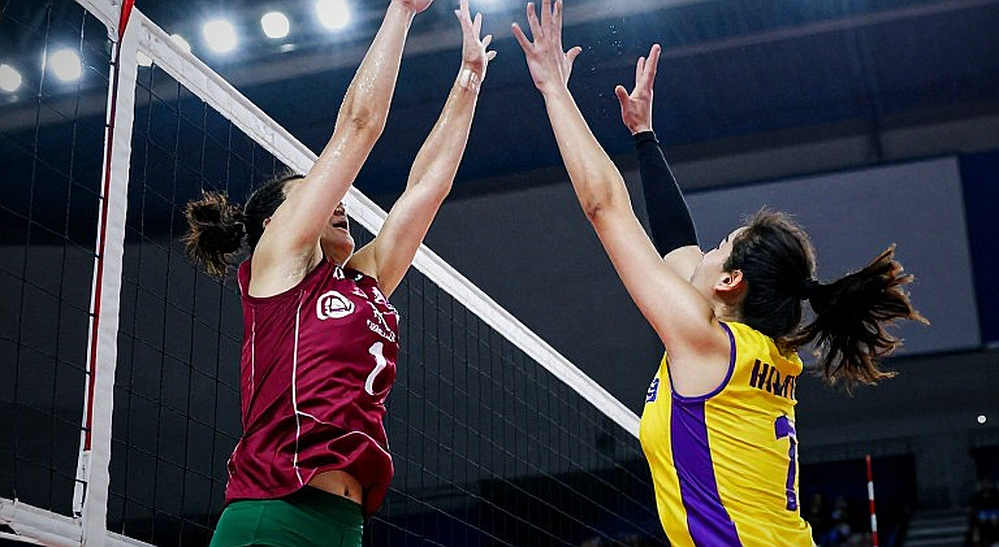
Losing one set across an entire pool stage is a positive sign, but it proves nothing about the pressure threshold. On the contrary, it is the quarterfinal that proves it — and it proves that threshold is fragile.
Heritage and present: two lines running in opposite directions
Cameroon has twelve podiums at the African Nations Championship: 2 golds (2026, 2026), 5 silvers, 5 bronzes. Looking at this number, anyone would default to reading them as a power.
But look at the recent line. Silver in 2026. Fourth in 2026. And Cameroon's most recent continental gold is 24 years old, dating back to 2026. This is not the image of a power rising. It is the image of a volleyball nation with heritage that has entered a plateau — perhaps even a mild decline.
At the continental level, Cameroon remains a genuine medal contender. At the global level, the story is very different. Cameroon's world ranking is No. 45. That figure is low even within Africa, and far below the threshold of a team that could threaten anyone at a world event.
World Championship history reinforces this: this will be Cameroon's sixth appearance, and their best result is 13th, from 2026. Six appearances, a peak of 13th — this is the portrait of a participation-tier side, not a contender.
I do not write this to diminish Cameroon. I write to separate two events that are being conflated in the headlines: on one hand, Cameroon has done something worthy of note by returning to a continental final; on the other, a World Championship ticket does not mean Cameroon has returned to the status of a power. These are two different stories, and mixing them is a familiar fallacy.
The format did its part of the work
The African Nations Championship uses a pool-plus-knockout format: pool play, quarterfinal, semifinal, final. This format has a built-in property any disciplinary professional must always flag: it rewards luck in decisive rallies more than overall form.
A team with overwhelming superiority can drop a set, even a match, and still advance. But a team that is level in everything can win the whole tournament on a single 16-14 set. Cameroon's quarterfinal is living proof of the randomness the knockout format introduces.
And if — I say if, because this is unverified — the final truly carries a direct Olympic berth, then this format turns a fifteen-point set in a single match into an enormous stake. Pressure in the decisive rallies would be amplified many times over. But that is an assumption, not a fact. And I will return to it later.
The biggest blind spot is named Tunisia
There is something anyone preparing for the final must face directly: the final between Cameroon and Tunisia is a match where half the data is entirely blank. The report only says Tunisia is there. Not one score, not one roster, not one journey.
By the hierarchy of African men's volleyball, Tunisia has long stood among the leaders alongside Egypt and Kenya, with a long history of Olympic appearances. Historically, Tunisia is regarded as one of the strongest teams on the continent. Their absence from the body of the report turns it into a purely Cameroon-centric piece — telling the story of half the court.
For a disciplinary professional, this is the most serious gap. I cannot analyze a final with data from only one team. Any conclusion about Cameroon's chances in the last match is pure speculation without Tunisia data.
The only thing I can say for certain: historically, Cameroon enters the final as the weaker side on paper. And in volleyball, paper does not decide the fifth set — but it shapes how the weaker team must play.
Contrarian angle: What is this report selling the reader
There is a familiar trap in sports journalism. When a team does something positive, the story instantly shifts into "return," "revival," "empire awakens." With Cameroon, that story needs a cold filter.
Look again at the data: a silver in 2026, a fourth in 2026. This is not a clear upward path. It is a flat line, tilting slightly down. A 24-year gap without continental gold means the so-called "Cameroon power" is largely a memory of the 1980s and 2026. Memory does not score points.
That is why I do not call this a "return." I call it a final appearance built on decisive rallies — more precisely, built on a 16-14 set and a dead-even point total.
Two terminology errors that cannot be ignored
This is the part where I, as a disciplinary professional, must speak in my strictest tone. This report makes two mechanism-level errors, and both can distort the reader's understanding of what the final actually earns.
Error one — naming the event. The headline says "World Cup 2027," the body says "World Championship." These are two different entities. The FIVB discontinued the World Cup after 2026. The premier men's event today is the World Championship, with the next edition in 2027. The "World Cup" in the headline is almost certainly an error, and it needs correcting before anyone reuses this information.
Worth noting: this kind of terminology drift is a hallmark of aggregated reports passing through multiple editing stages, not of an official FIVB or CAVB release. When the event name is wrong, the ranking and medal figures in the same report also deserve re-checking.
Error two — and more serious — the Olympic berth. The report says the final is for "a spot at the Los Angeles 2028 Olympics."
But in the Paris 2026 cycle precedent, volleyball did not award Olympic tickets through continental championships. The Olympic qualification path for volleyball runs through the Olympic Qualifying Tournaments and the world ranking — quite unlike basketball or football, where continental events carry direct berths. Until official documentation from the FIVB or CAVB confirms it, the claim of a direct continental Olympic berth must be treated as unverified.
If that mechanism does not exist, then this claim is not merely a technical error. It inflates a continental final into an event of Olympic scale and completely misleads readers about what is actually at stake.
And there is another ambiguity: the report does not specify whether the berth goes to both finalists or only the champion. In a match where the value of the prize depends on whether you win or lose, the difference between "both get it" and "only one team gets it" is the difference between an ordinary match and an all-or-nothing one. Not spelling that out is a material flaw in the report.
Here I am not accusing anyone of fraud. I am only saying: the biggest risk of this report does not lie on the court, but in the integrity of the information. And in my profession, when information is unverified, every conclusion built on it must be labeled "pending verification."
Why a floating fact matters
There is a reason I devote so much space to the terminology. African volleyball has a structural feature: men's teams on this continent are routinely underrated, under-reported, and ranked below their true level, partly due to frequency of play and partly because results are recorded scantily. This means every time African volleyball appears in the international press, it usually appears through a lens that is already distorted.
When a report about an African team earning a World Championship berth misnames the event and attaches an unverified Olympic berth to it, that distortion deepens. An empty arena, and I watch the referee tremble. Not from pressure, but from a lack of actors to perform for.
Takeaway: What I will track, and what I will not name
I do not conclude in place of the result on the court. A referee does not comfort, a referee rules. And my ruling on this data is: there are still too many gaps to call this a complete story.
The first thing I will track is the score of the final, and more specifically the shape of the sets. If Cameroon again enters a balanced fifth set, that will confirm that their high-variance profile is not chance but nature. A team that wins by the moment will always live and die by the moment.
The second, more important thing is the qualification mechanism. I will wait for official documentation from the FIVB and CAVB to know what this final actually awards. If an Olympic berth mechanism exists, the entire story of the event's value changes. If it does not, then most of what is being circulated about Cameroon's "Olympic dream" is only a rumor, carefully packaged.
The third is Tunisia's data. Without it, any read on the final is just talk outside the court.
Rules do not feed people, but people feed the rules with model rallies. And an African volleyball scene returning to the world stage will only be properly recognized when each of its wins is recorded with real numbers, real event names, and real mechanisms — not with headlines prettier than reality. The 2027 World Championship will be where Cameroon answers a question this continent has never answered: where does a No. 45 team stand on the world volleyball map once it steps outside its African comfort zone.